

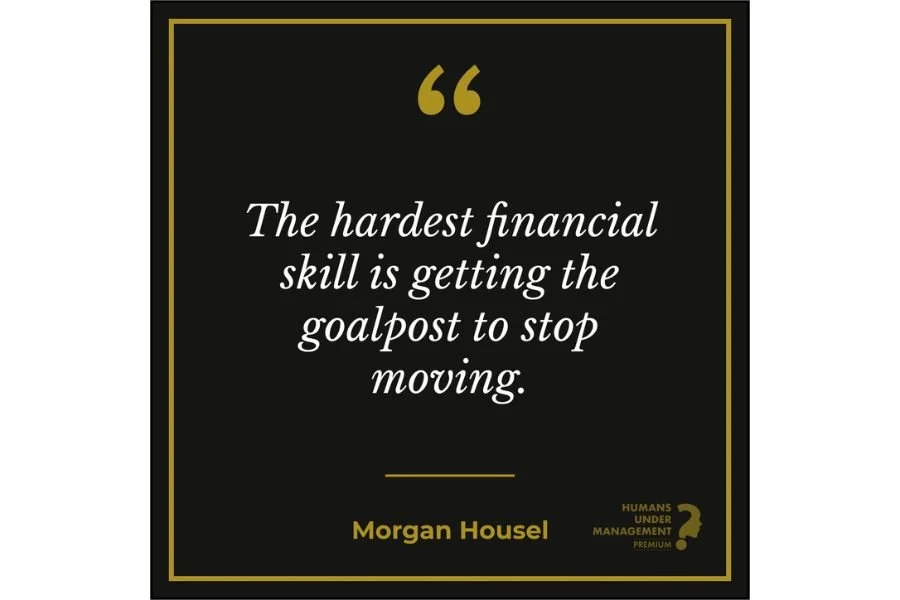
Financial goalposts
by Tim Walsham, Claritas Wealth
We only have to turn the clock back in our lives by 10 or 20 years and it’s likely that our financial goalposts have shifted.
The lifestyle that seemed fine at the time has been superseded by a ‘superior’ one that probably costs quite a bit more money.
It’s very easily done. We earn more money and advertisers and marketeers set to work to make sure we spend it.
Before we know it we have a new ‘baseline’ that we need to financially live up to.
Getting these financial goalposts to stop moving is a superpower that creates satisfied, comfortably wealthy individuals and families. If we can reach a level of comfort and satisfaction in our lives and either stop there or at least slow down the ‘lifestyle creep’, we probably have the recipe for happiness.
How we do that is another matter!
Self-reflection on where we came from and where we’ve got to can help. It’s easy to lose sight of that.
I’d be really interested to hear your thoughts about this. Please do get in touch.

The Kitchen Table and the Spreadsheet
by Tim Walsham, Claritas Wealth
Morgan Housel often writes about the idea that rational decisions that look great on a spreadsheet can break down in real life. A spreadsheet is logical and mathematically optimises outcomes. Sitting around the kitchen table are the emotions of real life, hopes and fears.
We’re not robots.
People panic sell in downturns even though staying invested is massively likely to be the better long term outcome.
The right level of savings can be abandoned when other priorities arise. The spreadsheet says to keep saving but the word on the street might be that job security has fallen through floor.
Morgan’s argument is that the best strategy is not the one with the highest expected return, but the one you can stick to when everyone around you is saying something different. Fear is the enemy.
This might mean taking slightly less risk than you should with your investments (thus reducing long term returns) or holding a bit more than is necessary in cash.
If that means that you stick to the strategy when it’s all hitting the fan then that makes perfect sense. Your ‘future self’ will thank you.

Look for an adviser that leads with the financial planning
The old school of financial advice is where the adviser leads with the investments.
Yes there will be a meeting with tea and biscuits and a bit of chat about the children but really it’s all about finding out how much money is available to invest and getting to the ‘close’ as quickly as possible.
It all a bit unedifying and doesn’t serve the client very well at all. The investments might be fine but where is the context?
What are the investments for? What are they trying to achieve for you? When is the money required and for what?
A much better approach is to lead with the financial planning.
This means a detailed discussion (where you do most of the talking!) about your lives, how you got to where you are now and where you want to be in the future. What are your hopes and fears and the things you’ll regret not doing in the future?
As far as we’re aware we only get one stab at this life and we also only have a certain number of healthy and sprightly years. A good financial planner will start by helping to articulate what your ideal life looks like and then see if the money can be matched to that.
Have you got enough to do all of the things that you want to do? If you’re still working then what needs to happen to close that gap? Can we put a plan in place for that?
If you’re not working anymore and we’re working with whatever you have now, what are the priorities and the potential trade-offs to make sure that you do the things that are most important to you?
After these discussions, it’s a case of matching the way your money is managed to when you need it. In the extreme, if you needed all of the money tomorrow then you would leave it in the bank and, in the other extreme, if you needed it all in 30 years then you could do something completely different, Obviously most people need different amounts of money at different times and this is where the financial planning comes in.
But only once we know what the money is for, how much you need and when.
Community Expert: Finance Cutting Out The Noise
by Claritas Wealth Management
At the time I’m writing this blog it feels like there are multiple seismic world events happening at roughly the same time.
Turmoil in Iraq, the President of Venezuela forcibly removed by the US, rhetoric from the US regarding Greenland, the ongoing Russia/Ukraine conflict and the troubles in Gaza.
There are obviously many more but these are the headlines dominating the news at the moment.
Where does this leave people trying to plan their financial futures?
The temptation is to focus on current world events and let that influence decisions that can have a lasting impact on your long term wealth.
World events may make you reluctant to invest and leave surplus funds in cash accounts that over the long term are likely to lose money relative to inflation. It might feel like a stock market downturn is inevitable bearing in mind everything that‘s going on at the moment.
The truth is that no-one knows but let’s focus on what we do know.
Stock market downturns do occur every so often. There’s no real pattern to it and there’s no reliable way of predicting them in advance in order to gain some kind of an advantage, i.e. coming out of the market at the right time and then re-entering.
In the long run, the stock market has been an incredible source of wealth generation and there’s no reason why it shouldn’t continue to do so in the future. Caveat – in the long run and with bumps in the road along the way. It’s how it has always been and how it always will be.
It’s really important to ignore the ‘noise’ of current world events when it comes to your own financial planning.
Focus on how much money you need to live a fulfilling life and when you are going to need it. This then informs how much should be retained in cash or other defensive assets. The rest can be in longer term stock market related assets and, because you know that you don’t need this money any time soon, you can relax around any short term fluctuations.
This is where an adviser can really help, firstly in the construction of the initial plan and, even more importantly, helping you stick to it when current world events cause you to have a bit of a wobble. You’re a human being and this is all completely normal. We can help.